
3D Printing Filaments Guide: PETG vs PA vs PPA vs PPS
August 5, 2026
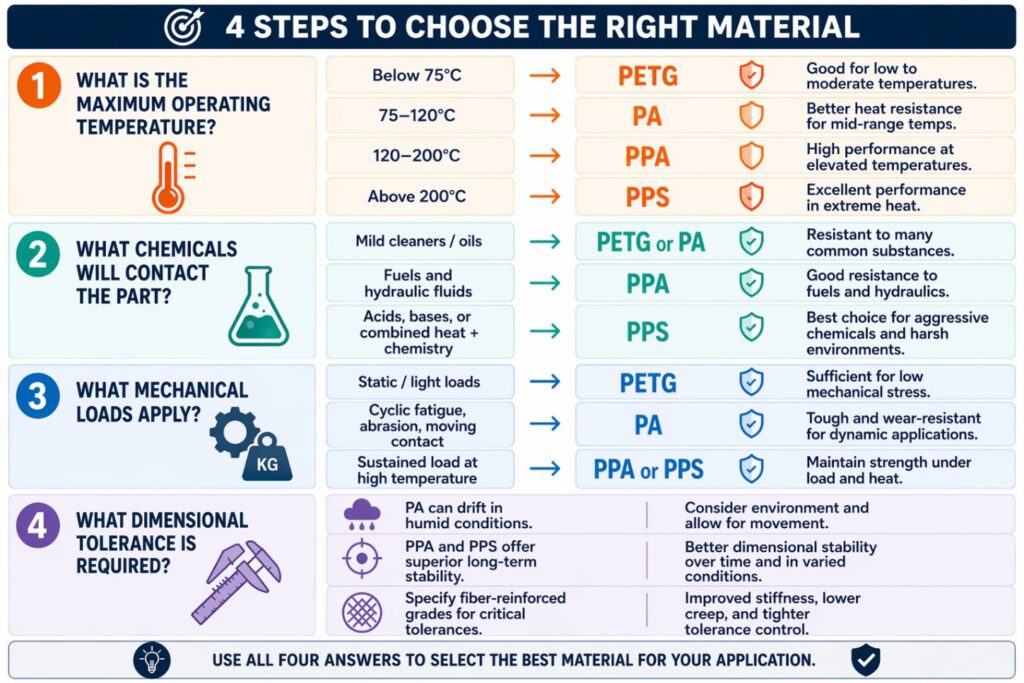
Key Takeaway:
Choosing the right 3D printing filament is the foundation of structural integrity in FDM manufacturing. The four leading engineering filaments sit on a clear performance ladder defined by thermal resistance, chemical compatibility, and mechanical load. Matching the polymer to the application’s real operating conditions, not just its shape, is what separates a part that lasts from one that fails in the field.
The Critical Role of Material Selection
Material selection is the single most consequential decision in industrial FDM 3D printing. The polymer chosen defines every performance property that follows: thermal resistance, chemical compatibility, dimensional stability, and fatigue life. Get it wrong, and no amount of print quality or design optimization will save the part. This guide compares PETG, PA, PPA, and PPS, the four engineering filaments that cover the vast majority of industrial FDM applications, to help you specify the right material the first time.
At-a-Glance Comparison
| Filament | Best For | Thermal Limit | Upgrade Trigger |
|---|---|---|---|
| PETG | Enclosures, brackets, jigs, functional prototypes | 70–80°C HDT | Above 75°C, solvent/fuel contact, sustained load |
| PA (Nylon) | Gears, cams, snap-fits, cable guides, automotive/industrial fixtures | Up to ~120°C | Above 120°C, or contact with fuels, hydraulic fluids, solvents |
| PPA | Under-hood automotive parts, fluid manifolds, oil & gas fittings | 150–230°C HDT | Approaching 200°C continuous, or strong acids/bases/halogenated solvents |
| PPS | Pump housings, valve bodies, high-voltage insulators, aerospace structural parts | Highest of the four; chemically inert to nearly all industrial fluids | No other polymer survives the combined thermal + chemical environment |
PETG: The Functional Prototype Baseline
PETG (Polyethylene Terephthalate Glycol) is the most printable engineering filament available. It combines good tensile strength, excellent layer adhesion, and low moisture uptake in a cost-effective package.
Best for: enclosures, brackets, jigs, fluid-contact housings, in non-aggressive environments, and functional prototypes.
Thermal Limit: 70-80°C heat deflection temperature. Not suitable above 75°C under load.
Upgrade Trigger: move beyond PETG once temperatures exceed 75°C, the part contacts solvents or fuel, or it carries sustained mechanical load.
PA (Nylon): The Mechanical Workhorse
Polyamide (PA6, PA11, PA12) delivers outstanding impact resistance, fatigue endurance, and a self-lubricating surface that makes it ideal for moving parts. It’s the default choice for mechanical end-use components.
Best for: gears, cams, snap-fit assemblies, load-bearing brackets, cable guides, and automotive or industrial fixtures.
Key Limitation: PA absorbs atmospheric moisture, which causes dimensional drift over time. For tight tolerances, use PA12 or a fiber-reinforced grade instead.
Upgrade Trigger: move beyond PA once operating temperatures exceed 120°C, or the part contacts fuels under pressure, hydraulic fluids, or industrial solvents.
PPA & PPS: High-Temperature 3D Printing Filaments
When PA reaches its thermal or chemical limit, PPA and PPS take over as the two high-temperature 3D printing filaments built for the harshest environments.
PPA (Polyphthalamide) is a semi-aromatic polyamide that extends nylon’s capabilities into high-temperature and chemically aggressive environments. Its aromatic backbone delivers dramatically higher thermal stability with lower moisture uptake than PA6 or PA12. It’s best suited to under-hood automotive components, fluid manifolds, oil & gas fittings, industrial tooling exposed to process chemicals, and structural brackets in high-temperature zones. Its thermal range runs 150–230°C HDT, higher still with glass or carbon-fiber reinforcement. Move beyond PPA once continuous operating temperatures approach 200°C, or the part is exposed to strong acids, bases, or halogenated solvents.
PPS (Polyphenylene Sulfide) is the engineering ceiling of FDM. It’s the highest-performance FDM thermoplastic available: inherently flame retardant (UL94 V-0), autoclave-compatible, and chemically inert to nearly all industrial fluids — including strong acids, bases, fuels, and halogenated solvents — even at elevated temperatures. It’s the material of choice for chemical processing components (pump housings, valve bodies), high-voltage electrical insulators, medical devices requiring sterilization, and aerospace structural parts. Choose PPS when no other polymer survives the combined thermal and chemical environment of the application.
Mastering Industrial FDM Material Selection
Technical performance properties, not appearance or printability alone, define the success of industrial FDM material selection for end-use parts. Environmental factors that must dictate the final material specification include:When PA reaches its thermal or chemical limit, PPA and PPS take over as the two high-temperature 3D printing filaments built for the harshest environments.
- Heat: continuous operating temperature and any short-term thermal spikes
- Chemicals: exposure to fuels, solvents, acids, bases, or cleaning agents
- Mechanical load: sustained stress, impact, vibration, or fatigue cycling
Walking the ladder from PETG to PA to PPA to PPS is essentially a walk up the thermal and chemical resistance scale. Specifying too low a material risks premature failure in the field; specifying too high adds unnecessary cost. The goal is the lowest-cost material that still comfortably clears the part’s real operating envelope.
Utilizing a Professional 3D Printing Filaments Guide as a Starting Point
A filament comparison like this one is a starting point, not a substitute for validating a specific part against its actual service conditions. For parts operating near a material’s thermal or chemical limit, or where reinforcement (glass or carbon fiber) changes the performance profile, it’s worth confirming the specification with a team that prints these materials daily. See Celette’s Materials Datasheets for detailed technical data sheets on each of these filaments.
What is the best 3D Printing filament for high temperatures?
PPS offers the highest thermal and chemical resistance of the four filaments covered here, followed by PPA. Both are suited to continuous high-temperature environments where PETG or standard PA would fail.
Is PA (Nylon) or PETG better for mechanical parts?
PA is the better choice for moving or load-bearing mechanical parts — gears, cams, snap-fits — thanks to its impact resistance and self-lubricating surface. PETG is better suited to static enclosures, brackets, and prototypes in non-aggressive environments.
When should I use PPA instead of PA?
Move from PA to PPA once operating temperatures exceed roughly 120°C, or the part will contact fuels, hydraulic fluids, or industrial solvents that standard nylon can’t withstand.
Can these filaments be reinforced with carbon fiber?
Yes. Carbon-fiber reinforced grades of PA, PPA, and PETG are common and further increase stiffness and thermal stability, which is a core part of Celette’s carbon fiber 3D printing services offering.